How Hearing Loss Impacts a Child’s School Performance - Listening Ears

◉ 19 November 2025

◉ 3 Min Read

◉ Author: Bakul Chaudhary

Hearing loss can make it hard for children to listen, understand lessons, and communicate in class. Studies show that around 15% of school-aged children have some degree of hearing difficulty, which can lead to trouble following lessons, speaking clearly, and keeping up with classmates. Early detection helps improve both learning and confidence. Experts in pediatric audiology confirm that early detection and intervention can improve academic outcomes significantly, boosting both learning and confidence.

What Happens When a Child Can’t Hear Clearly

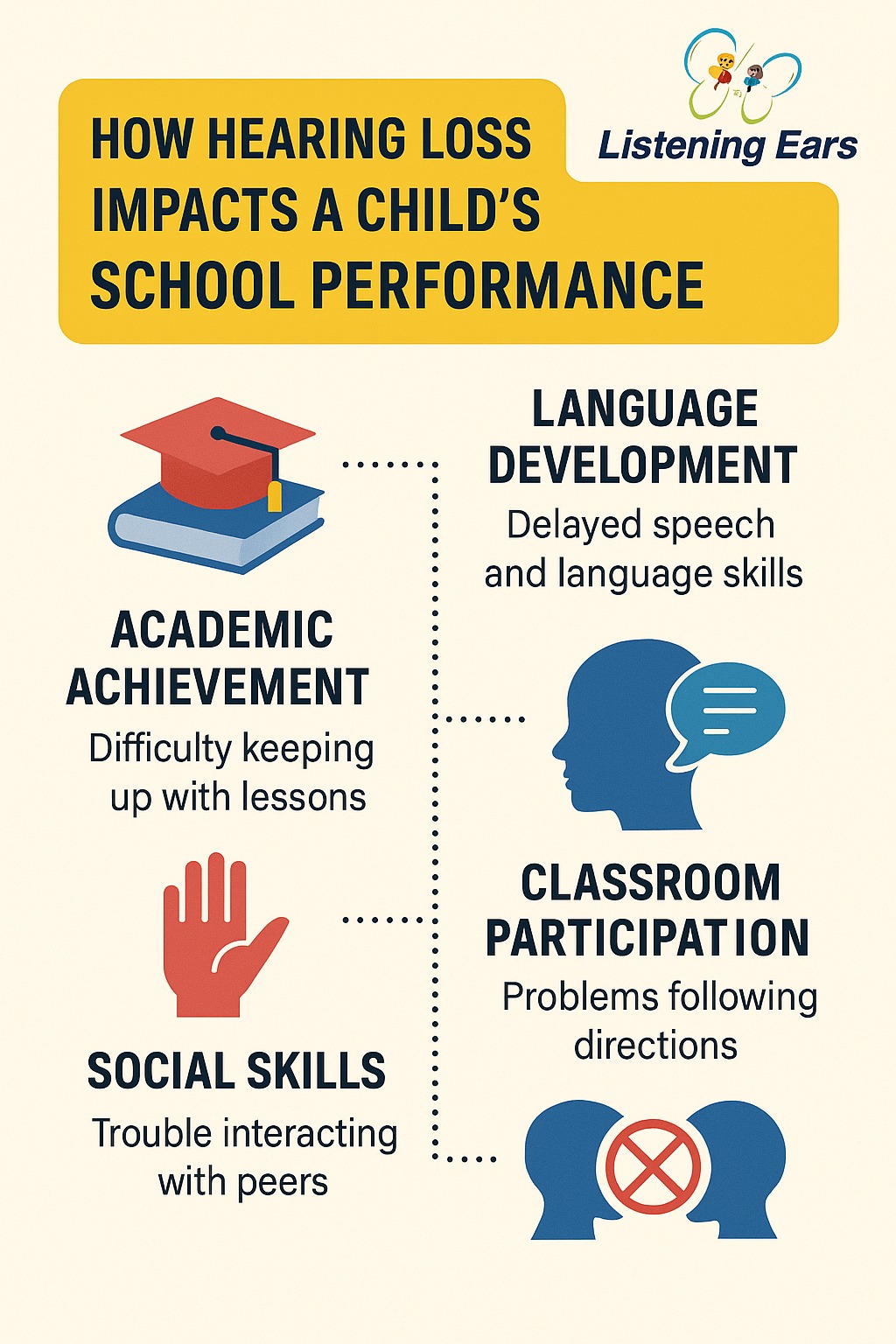
When a child has trouble hearing, it can make learning in school very hard. Hearing is important for listening to the teacher, learning new words, and talking with friends. If a child doesn’t hear well, they might miss important parts of lessons and have trouble understanding what’s being taught.

Real Facts You Should Know

According to the American Speech-Language Hearing Association (ASHA), children with mild to moderate hearing loss can fall one to four grade levels behind their classmates if they don’t get help early. Those with more serious hearing loss may struggle to go beyond third grade if they don’t get special support.

Why Hearing Is So Important for Learning

Hearing helps children:

  • Learn how to speak clearly
  • Understand new words and build strong vocabulary
  • Follow directions in class
  • Talk and share ideas with others
  • When hearing is weak, these skills develop slowly, and that can make schoolwork — especially subjects like reading and writing — more difficult.

How It Affects School Subjects


Children with hearing loss often find language-based subjects harder. They may:


  • Struggle to understand long sentences
  • Miss words when the teacher talks
  • Get confused by tricky phrases or idioms (like “break the ice” or “hit the books”)
  • Have trouble spelling or reading new words
  • Social Life in School Also Gets Affected
  • Hearing loss doesn’t just make learning tough — it can also affect friendships. When a child can’t hear well, it’s hard to join conversations or group games. They may feel shy, left out, or sad because others might not understand what’s wrong. Over time, this can make them feel lonely or frustrated.

How Teachers and Parents Can Help

Teachers and parents play a big role in spotting hearing problems early. Some signs to look for include:

  • Not paying attention in class
  • Giving wrong answers to questions
  • Asking people to repeat things often
  • Talking too loudly or too softly
  • Watching others’ lips closely to understand speech
  • If these signs appear, it’s time for a hearing test.
  • What Should You Do If You Think a Child Has Hearing Problems?

If your child struggles in school, doesn’t respond when called, or often says “What?” or “Huh?”, they might need a hearing check-up. Visit a qualified audiologist for a full hearing test. The earlier the problem is found, the easier it is to help your child do better in school and feel happy again.

Impact of Hearing Loss on Child’s School Performance – Comparison Table

Area of ImpactMild to Moderate Hearing LossSevere Hearing Loss (Without Support)With Early Intervention & Support
Academic AchievementCan fall 1-4 grade levels behind peersMay struggle to progress beyond 3rd grade levelCan achieve grade-level performance or close to it
Language DevelopmentDelayed vocabulary building, some speech clarity issuesSignificantly delayed speech and language skillsImproved vocabulary and clearer speech patterns
Reading & WritingDifficulty with spelling, reading comprehension challengesSevere struggles with literacy skillsEnhanced reading and writing abilities
Classroom ParticipationMisses parts of lessons, needs frequent repetitionUnable to follow most verbal instructionsActive participation with accommodations
Speech ClarityMild articulation problemsSignificant speech difficultiesBetter pronunciation and communication
Understanding InstructionsConfusion with complex or multi-step directionsCannot follow most verbal directionsAble to understand with proper support
Social InteractionSome difficulty joining group activitiesIsolated, limited peer interactionImproved friendships and social confidence
Emotional Well-beingMay feel frustrated or left out at timesHigh risk of loneliness, low self-esteemBetter confidence and emotional health
Comprehension of Idioms/Abstract LanguageStruggles with figurative speechVery limited understandingGradual improvement with teaching support

Warning Signs Teachers & Parents Should Watch For

CategorySigns to Look For
Behavioral SignsNot paying attention in class, seems distracted or inattentive
Response PatternsFrequently says “What?” or “Huh?”, asks for repetition often
Academic PerformanceGives incorrect or irrelevant answers to questions
Communication StyleTalks too loudly or too softly, watches lips closely while listening
Social BehaviorAvoids group activities, appears shy or withdrawn

Key Statistics

StatisticSource/Detail
Percentage of school-aged children with hearing difficultyApproximately 15%
Potential grade level delay without early help1-4 grade levels behind (mild to moderate loss)
Maximum education level without support (severe loss)May not progress beyond 3rd grade level
Reporting organizationAmerican Speech-Language Hearing Association (ASHA)


Recent Event at Listening Ears

Listening Ears recently hosted an ADHD Awareness and Parent Coaching Workshop in Delhi, where families learned simple, science-backed strategies to manage hyperactivity and improve focus at home. The session included live demonstrations of reward-based behavior systems and calm-down techniques that parents can easily use in daily routines.

Our Expertise in Behavioral Therapy

Our Child Psychology and Behavioral Therapy Unit specializes in helping children with ADHD and attention challenges build focus, confidence, and self-control through structured play, parent training, and school-based collaboration. We believe that with the right tools and support, every child can thrive both at home and in the classroom.

Final Thoughts

Hearing loss doesn’t have to stop a child from doing well in school. With early help, the right hearing aids, and support from teachers and parents, every child can learn, make friends, and succeed.

If you notice any signs of hearing difficulty, visit Listening Ears .. They offer professional hearing tests, child-friendly care, and modern hearing solutions to help your child hear better and perform better in school.

FAQ's

Can a child with hearing loss still go to a normal school?

Yes! With hearing aids and teacher support, children with hearing loss can study in regular schools and do well.

What are the first signs of hearing loss in kids?

They may not respond when called, turn up the TV volume too high, or ask people to repeat things often.

Can hearing loss cause low grades?

Yes, missing important classroom sounds or instructions can lead to poor grades and confusion.

Do hearing aids really help in school?

Absolutely! Hearing aids make sounds clearer so children can listen, learn, and speak more easily.

Is hearing loss the same as being deaf?

 No. Some children have partial hearing loss and can still hear some sounds. Deafness means they can’t hear at all.

Can ear infections cause hearing problems?

Yes, frequent ear infections can damage hearing if not treated early.

Who can check my child’s hearing?

An audiologist is a trained expert who tests hearing and suggests the right treatment.

What’s the best age to test a child’s hearing?

It’s good to test hearing as early as possible — even babies can get tested!