
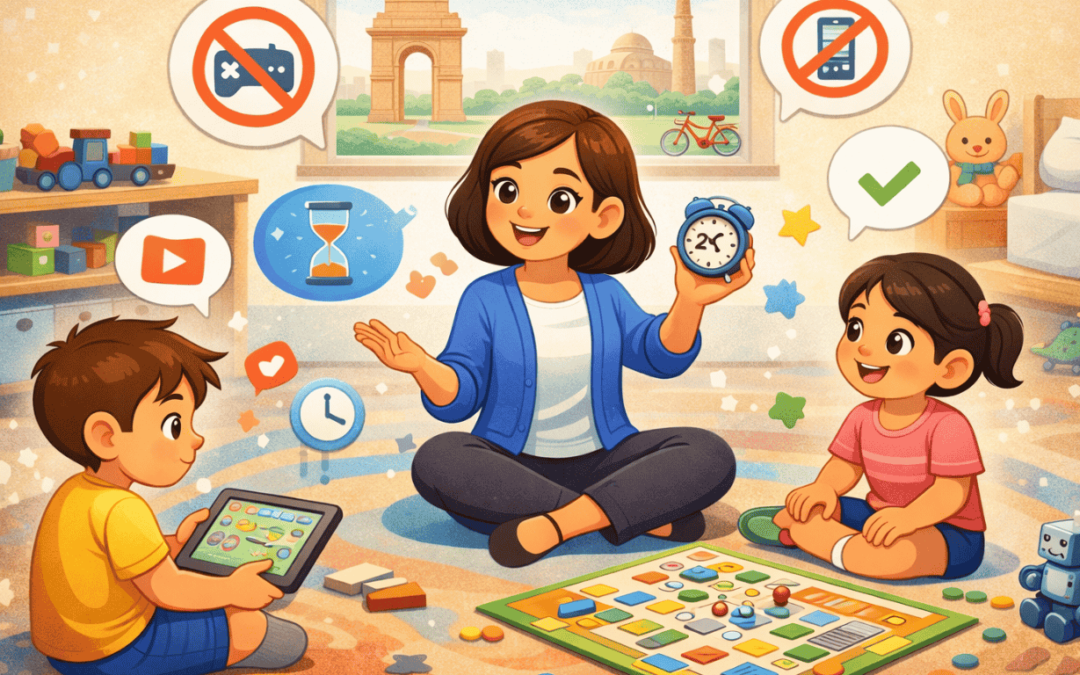
Excessive screen time in Delhi children reduces real talking, listening, and interaction, which directly affects speech, language, attention, and social skills. Managing screen time early helps children develop clear speech, better understanding, and stronger communication skills.
Why Screen Time Is a Big Issue for Delhi Kids
Delhi is a fast-paced city. Parents work long hours, travel in traffic, and manage busy schedules. Screens often become an easy way to keep children engaged. Phones, tablets, TVs, and online classes are now part of daily life.
But screens cannot replace human interaction. Children learn speech by hearing real voices, watching mouth movements, and responding to people—not screens.
Why Delhi’s Environment Makes Screen Time Worse
Due to pollution, traffic, and safety concerns, many Delhi children spend more time indoors.
This increases screen exposure while reducing outdoor play, peer interaction, and natural conversation—all of which are essential for speech development.
How Children Learn Speech (Simple Explanation)
Children learn to talk by:
- Hearing words again and again
- Watching facial expressions
- Copying sounds
- Getting responses like smiles, corrections, and encouragement
Screens talk to children, but they do not listen back. This breaks the learning loop.
Real and Accurate Stats on Screen Time and Speech
- The World Health Organization recommends no screen time below 2 years
- Children aged 2–5 should have less than 1 hour per day
- Studies show children with high screen exposure have 2 times higher risk of speech delay
- Indian urban children spend 3–5 hours daily on screens on average
In metro cities like Delhi, screen exposure starts earlier and lasts longer.
Why Delhi Children Are More Affected
Smaller Living Spaces
Many Delhi families live in apartments where outdoor play is limited. Screens become the main entertainment source.
Safety Concerns
Pollution, traffic, and lack of open parks reduce outdoor interaction.
Online Learning Culture
Online classes increased screen dependence, even for very young children.
Nuclear Families
Limited sibling interaction means fewer chances for natural conversation.
Age-Wise Screen Time Red Flags
By 18 months:
- No words
- Poor eye contact
By 2 years:
- Less than 20–30 words
- Only pointing or crying
By 3 years:
- Speech not clear
- Uses screens more than people
If you notice these signs, screen time may be affecting speech.
Common Speech and Behavior Problems Linked to Excess Screen Time
Delayed Speech
Children may say fewer words or start speaking late.
Poor Eye Contact
Screen-focused children avoid face-to-face interaction.
Weak Attention Span
Children struggle to sit, listen, or follow instructions.
Repetition Without Understanding
Children repeat lines from videos but cannot use words meaningfully.
Reduced Social Skills
Difficulty playing or communicating with other children.
Screen Time vs Real Interaction Comparison Table
Aspect | High Screen Time | Healthy Screen Management |
Type of Learning | Passive watching | Active interaction |
Child’s Role | Only listening and watching | Speaking, listening, responding |
Vocabulary Development | Limited and memorized | Meaningful and usable |
Sentence Formation | Weak or delayed | Strong and age-appropriate |
Eye Contact | Poor | Improves naturally |
Attention Span | Short and scattered | Better focus and listening |
Social Skills | Reduced peer interaction | Improved communication |
Emotional Expression | Difficulty expressing feelings | Better emotional communication |
Understanding Instructions | Often poor | Clear and improved |
Speech Clarity | Unclear or delayed | Clearer pronunciation |
Parent-Child Bond | Low interaction | Strong bonding |
Learning Speed | Slower progress | Faster language growth |
Behavior Impact | Irritability, frustration | Calm and cooperative |
Long-Term Effect | Higher risk of speech delay | Healthy communication development |
A Speech Therapist’s Local Experience (Expert Insight)
Speech therapists in Delhi increasingly see children who:
- Know alphabets and numbers from videos
- Cannot ask for water or express feelings
- Have unclear speech despite “learning apps”
This shows screen learning does not equal language learning.
Facts and Myths About Screen Time
Myth: Educational videos help children speak faster
Fact: Passive watching does not build real speech skills.
Myth: Screens improve vocabulary
Fact: Words learned without interaction are rarely used meaningfully.
Myth: Screens calm hyperactive children
Fact: They often worsen attention and behavior issues.
Myth: Online content can replace talking
Fact: Human interaction is irreplaceable.
How Much Screen Time Is Safe?
For Babies (0–2 years)
- Zero screen time
- Focus on talking, singing, and play
For Toddlers (2–5 years)
- Maximum 30–60 minutes
- Only with adult interaction
For School-Age Children
- Balanced use
- Clear limits and screen-free routines
Practical Screen Management Tips for Delhi Parents
Create Screen-Free Zones
Make meals, bedtime, and family time completely screen-free. These moments give children natural chances to listen and speak. Regular talking during these times builds strong language habits.
Talk More Than You Think
Speak to your child throughout the day about simple activities. Ask small questions and pause to let them respond. This teaches turn-taking and real conversation skills.
Encourage Outdoor Play
Outdoor play gives children space to talk, shout, and interact freely. Even short visits to parks help improve confidence and social communication. Fresh air also improves focus.
Replace Screens with Interaction
Storytelling, pretend play, and board games involve talking and listening. These activities help children use words meaningfully. Interaction strengthens speech faster than videos.
Be a Role Model
Children copy what adults do more than what they are told. When parents reduce their own screen use, children follow naturally. Healthy habits start at home.
When Screen Time Becomes a Speech Concern
Consult a speech therapist if your child:
- Is not talking as expected for age
- Repeats videos but cannot communicate
- Avoids eye contact
- Gets frustrated while expressing needs
Early guidance prevents long-term problems.
Speech Delay or Just Screen Habit?
Some children improve quickly when screen time is reduced and interaction increases.
Others may still need therapy.
A speech assessment helps identify whether your child needs habit correction, therapy, or both.
Role of Speech Therapy in Screen-Affected Children
Speech therapy helps by:
- Rebuilding attention and listening skills
- Encouraging real communication
- Guiding parents on daily interaction strategies
- Reducing screen dependence gradually
Therapy focuses on habits, not just words.
Why Early Action Matters
The brain develops fastest before age 6. Reducing screen time and increasing interaction during this phase leads to faster and better improvement.
Waiting allows poor habits to settle and delays progress.
Final Thoughts
Screens are part of modern life, especially in Delhi, but uncontrolled use silently harms speech and communication. Managing screen time is not about removing technology—it’s about balancing it with human connection.
Centers like Listening Ears help parents understand screen impact, guide healthy habits, and support children in developing strong speech and communication skills early.
FAQs
- How much screen time is too much for toddlers?
More than one hour daily is considered excessive. Toddlers need interaction, not passive watching. Less screen time improves speech development. - Can screen time cause speech delay?
Yes, excessive screen exposure reduces real conversation. This slows language learning. Many delayed children show high screen dependence. - Are educational apps helpful for speech?
They can support learning only with adult interaction. Alone, they do not build communication. Talking is more effective than tapping. - My child talks after watching videos. Is that okay?
Repeating words without understanding is common. Real communication involves using words meaningfully. Therapy helps build that skill. - Should screens be stopped completely?
No, screens can be used in limits. Balance and interaction are key. Complete removal is not always necessary. - Can reducing screen time improve speech?
Yes, many children show improvement within weeks. Increased talking boosts learning. Consistency is important. - What activities replace screen time best?
Story reading, pretend play, singing, and outdoor games work well. These activities encourage speech naturally. - Why choose Listening Ears for guidance?
Listening Ears offers practical, parent-friendly support. The focus is on real-life habits and child comfort. The goal is confident communication.