
Expertise & Written By
Ms. Bakul Chaudhary
Licensed Psychologist | Child & Developmental Psychologist | DIR Floortime Practitioner | Parent Counsellor | Language Therapist | Trained AVT Practitioner
Written By:
Content Team (With expert review for accuracy and clarity)
Occupational therapy exercises are simple activities that help children improve their daily life skills, motor skills, focus, and independence. Parents can easily practice exercises like grasping objects, hand strengthening, sensory play, balance activities, and routine-based tasks at home. When done regularly, these exercises help children become more confident and independent.
What is Occupational Therapy?
Occupational therapy (OT) helps children develop the skills needed for daily activities such as:
- Eating
- Writing
- Playing
- Dressing
- Concentrating
It focuses on improving fine motor skills, coordination, sensory processing, and independence.
Centers like Listening Ears guide parents on how to continue therapy at home for better results.
Why Occupational Therapy is Important for Children
Some children struggle with basic daily tasks. Occupational therapy helps them improve step by step.
- Builds independence in daily activities
- Improves hand and body coordination
- Enhances focus and attention
- Supports school readiness
- Reduces frustration and behavioral issues
Early support from Listening Ears can make a big difference in a child’s development.
Importance of Occupational Therapy
Occupational therapy plays a very important role in helping children become independent in their daily life. Many children face difficulties in simple tasks like holding a pencil, buttoning clothes, or focusing on activities. Occupational therapy helps improve these skills step by step.
- Helps children perform daily activities independently
- Improves hand strength and fine motor skills
- Enhances focus, attention, and learning ability
- Supports better coordination and balance
- Reduces frustration and builds confidence
With the right guidance children can develop essential life skills that support both school and home activities.
Early occupational therapy not only improves current challenges but also builds a strong foundation for a child’s future growth and development.
Real Stats You Should Know
- Around 5–15% of children face developmental or motor skill challenges
- Early occupational therapy improves functional skills by 40–60% faster
- Children receiving therapy show better performance in school activities
- Consistent home practice increases success rate significantly
This shows that regular OT exercises at home are very effective.
Occupational Therapy Exercises Parents Must Know
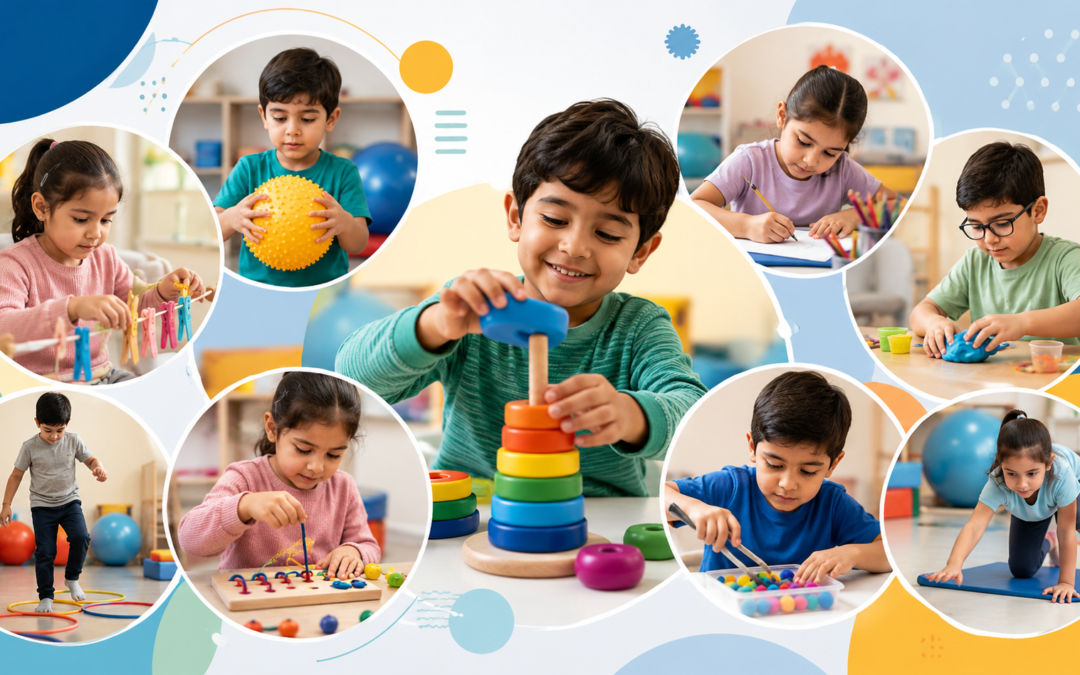
1. Hand Strengthening Activities
Use clay, dough, or sponge squeezing exercises. These activities improve grip strength and prepare children for writing.
2. Picking Small Objects
Ask your child to pick beads, coins, or buttons using fingers. This improves fine motor skills and finger control.
3. Drawing and Coloring
Encourage your child to draw shapes and color within lines. This helps improve hand control and coordination.
4. Buttoning and Zipping Practice
Teach your child to button shirts or zip bags. These are daily life skills that build independence.
5. Sensory Play Activities
Play with sand, water, rice, or textured materials. This improves sensory processing and comfort with different textures.
6. Balance and Movement Activities
Activities like standing on one leg, jumping, or walking in a straight line improve body coordination.
7. Cutting with Scissors
Use child-safe scissors to cut paper. This improves hand control and coordination.
8. Stacking and Building Blocks
Building blocks improve problem-solving, coordination, and creativity.
9. Daily Routine Tasks
Encourage your child to help in small tasks like arranging toys or setting the table. This builds responsibility.
10. Eye-Hand Coordination Games
Activities like catching a ball or threading beads improve coordination and focus.
Problems & Solutions
Problem 1: Child Has Weak Hand Strength
Solution: Use squeezing and gripping exercises daily
Problem 2: Poor Focus and Attention
Solution: Use short and engaging activities
Problem 3: Difficulty in Daily Tasks
Solution: Practice routine-based activities like dressing and eating
Problem 4: Sensory Issues
Solution: Introduce sensory play gradually
Problem 5: Lack of Consistency
Solution: Create a daily routine for exercises
Detailed Comparison Table
Skill Area | Without OT Exercises | With Regular OT Practice |
Fine Motor Skills | Weak | Strong |
Coordination | Poor | Improved |
Independence | Low | High |
Focus | Limited | Better |
Daily Activities | Difficult | Easy |
Facts vs Myths
Myth: It is only for severe conditions
Fact: Occupational therapy improves daily life skills
Myth: Therapy only works in clinics
Fact: Home practice is very effective
Myth: Children will improve automatically
Fact: Early intervention gives faster results
Myth: Therapy is boring
Fact: Play-based activities are helpful
What Should Parents Focus On?
- Consistency in daily practice
- Fun and engaging activities
- Encouragement and patience
- Small progress over perfection
Why You Should Choose Listening Ears
- Personalized therapy plans
- Child-friendly and practical approach
- Focus on real-life skills
- Continuous support for parents
Listening Ears helps parents understand how to support their child effectively at home.
Occupational Therapy Support in Noida & Delhi
If you are looking for occupational therapy in Noida, Listening Ears provides structured and child-friendly therapy programs designed to improve your child’s daily life skills, coordination, and independence. Each session is personalized based on your child’s needs, ensuring better and faster progress. Along with occupational therapy, you can also get support for speech therapy if required.
If you need expert care for your child in occupational therapy in Delhi, Listening Ears offers a combined approach that focuses on both functional skills and overall development. The therapy sessions are interactive and guided by professionals, helping children improve their motor skills, focus, and daily activities. Speech therapy support is also available where needed.
Visiting a center ensures proper assessment, regular monitoring, and faster improvement in your child’s development.
Book Free Online Consultation
If you are not sure where to start, you can take a free consultation with Listening Ears.
- Understand your child’s development level
- Get expert advice on exercises
- Learn how to support your child at home
- Plan therapy if required
Early guidance helps you take the right steps.
Simple Daily Routine for Parents
- Practice 15–20 minutes daily
- Use play-based activities
- Encourage independence
- Repeat exercises regularly
- Stay patient and positive
Bottom Line
Occupational therapy exercises at home can greatly improve your child’s independence, coordination, and confidence. Simple daily activities can make a big difference when done consistently.
For best results, combine home practice with expert guidance from Listening Ears to support your child’s complete development.
FAQs
1. What is occupational therapy for children?
Occupational therapy helps children develop daily life skills. It focuses on motor skills, coordination, and independence. It supports overall development.
2. Can I do occupational therapy at home?
Yes, many exercises can be done at home. Daily practice improves results. Professional guidance is helpful.
3. How often should I practice OT exercises?
Daily practice for 15–20 minutes is enough. Consistency is important. Regular practice gives better outcomes.
4. What are signs my child needs OT?
Difficulty in writing, holding objects, or daily tasks are signs. Poor coordination is also a sign. Early evaluation is important.
5. Are OT exercises safe?
Yes, they are safe and child-friendly. Most activities are play-based. Children enjoy them.
6. How long does OT take to show results?
It depends on the child’s condition. Some improve quickly, others take time. Consistency is key.
7. Can OT help in school performance?
Yes, it improves writing, focus, and coordination. This helps in better learning. It supports school readiness.
8. Where can I get OT support?
You can visit Listening Ears for expert guidance. They provide personalized therapy plans. Early consultation is recommended.
Disclaimer
This blog is for informational purposes only. Every child is different, and therapy should be started based on professional evaluation.